Showing posts with label horror. Show all posts

Thursday, April 30, 2015

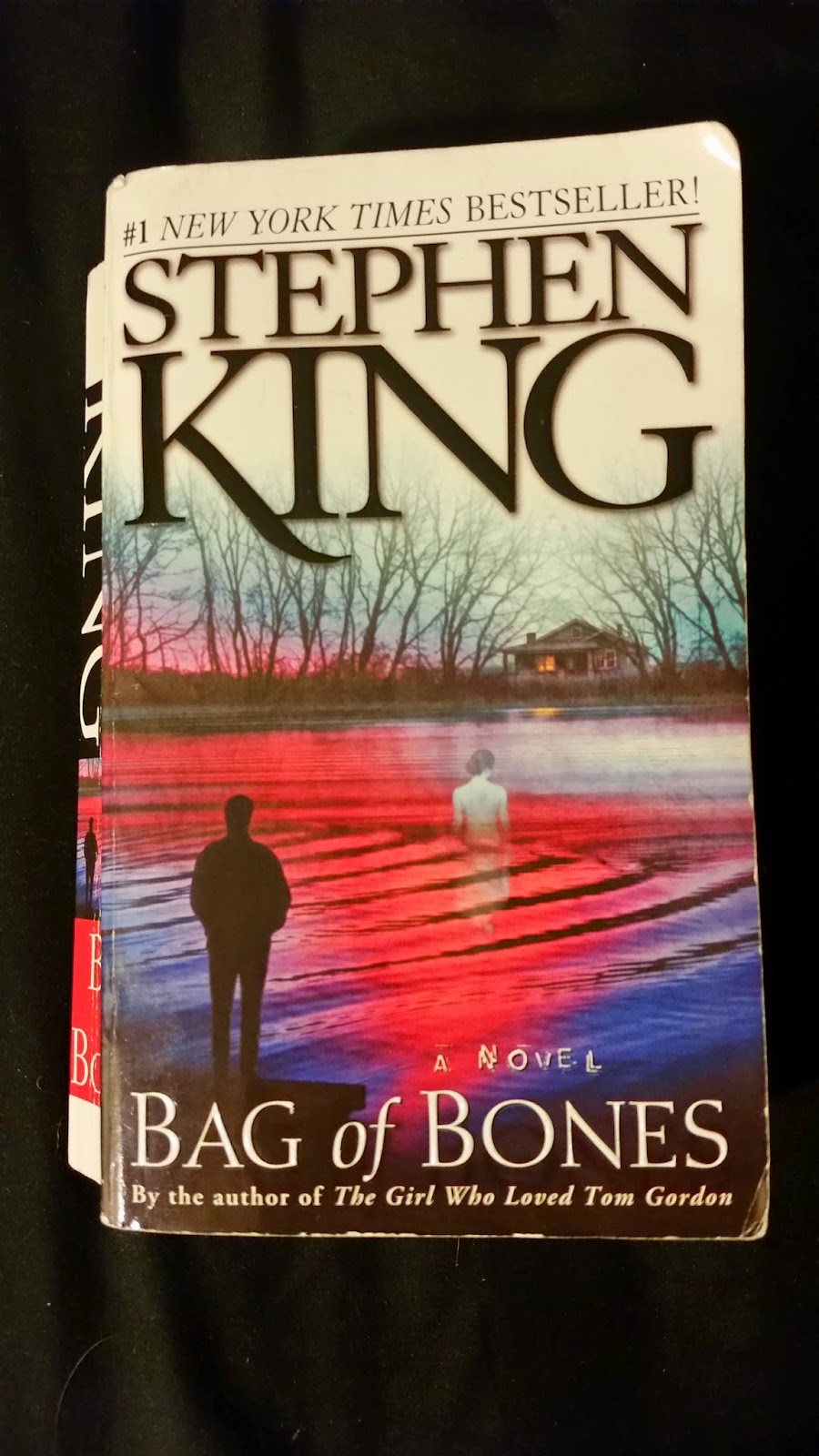
Bag of Bones

Bag of Bones
by Stephen King
p. 1998


Michael Noonan is haunted.

As the tragic lead protagonist in Stephen King’s 1998 novel, widower Mike Noonan finds him at the center of several dangerous and emotional plots when he retreats to his summer home in an attempt to move on with his life.

Bag of Bones is only my second King novel, and it leans closer to the genre he is best known for: horror and suspense. Indeed, the sprawling, multi-layered story is in turns mysterious, disturbing, tragic and dark. It wasn’t as long as my first King novel, but then few books are. It does, however, share some themes that may be King trademarks, not the least of which is having a widowed male protagonist who could be a stand-in for King himself. In this case, it is a little more transparent: Mike Noonan is a popular author who finds himself unable to write a single word since the unexpected death of his wife, Johanna, some years earlier.

In an attempt to make sense of the strange nightmares he keeps having, Mike decides to go to the location that keeps recurring in them: his vacation house on Dark Score Lake in small town Maine, nicknamed Sara Laughs for its notorious history with an old blues singer, Sara Tidwell. On his first day back, Mike’s life becomes intertwined with that of a young mother, Mattie Devore, and her 3-year-old daughter, Kyra. Reminded of his own childless marriage and attracted to the alluring Mattie—herself a young, tragic widow—Mike becomes embroiled in an ensuing custody battle for Kyra, led by the girl’s paternal grandfather, a multi-millionaire tycoon who is determined to always get what he wants.

Bag of Bones is a long book but it needs to be; there are plenty of plot threads, each with its own respective history, that are thoroughly explored before all coming together at the climax of the story. This is not a gory horror novel, as the suspense relies mainly on ghostly encounters and nightmarish secrets, but there are some starkly disturbing elements, especially that of the fate of Sara Tidwell and her kin and the ultimate fate of Mattie Devore, the latter of which took me especially by surprise. I did not expect King to kill his female lead so violently (after mercifully letting the main couple live in The Stand), but I guess I should have seen it coming. Mattie and Kyra were just so disgustingly precious that they couldn’t possibly be allowed to endure past novel’s end. I mean, where would the story be in that?

Though there were no female-to-female relationships in Bag of Bones (outside of the mother-daughter relationship), the novel is possessed and led by the actions of many interesting female characters: Mattie and Kyra, who provide the immediate action for the plot; Jo, who—though long deceased—haunts Sara Laughs and guides Mike on his spiritual journey to the truth; Sara Tidwell, whose fate began a curse culminating in the final showdown of the present, and Sara Laughs—the house who is herself like a living, breathing character. Even Max Devore’s spindly, prickly assistant, Rogette Whitmore, is a dynamic if villainous character who brings life to the novel, even if she is, at times, a bit over the top. I only wish that Mattie didn’t present as such a disposable character. Arguably the female lead, she should have presented as a stronger character, but she relied heavily on others to save her, and felt like more of a temptation and a complication for Mike than an individual. I have to admit I was a little grossed out by his fantasizing about this girl half his age, and it gets weirder when you realize that Mattie was really only a means of Mike getting what he always wanted (his own child), before being conveniently disposed of. Perhaps that last part is an oversimplification, perhaps not. The story is about the haunting of Mike Noonan, after all, everyone else is necessarily secondary to the story.

I didn’t enjoy this story as much as The Stand; even though it was somewhat shorter, I feel it dragged on at times, or took too long to get to the action, but these were minor points of contention for me. For the most part, I like slow-boiling plots and character-driven stories, as long as they are presented with a modicum of poetry and poise, and Stephen King is wonderful at demonstrating those. It mostly comes down to my genre preferences: The Stand is a post-apocalyptic story, one of my favorite genres, while Bag of Bones, a horror novel, is a genre I’m less likely to be invested in. The fact is, horror stories, to someone as pragmatic as I typically am, require much more suspension of disbelief. If Bag of Bones had culminated in a psychological and wholly realistic finale as opposed to a mystical one, I might have a different opinion altogether.

Wednesday, December 31, 2014

Who Are You

Blackout
by Rob Thurman

p. 2012


The sixth novel in Rob Thurman’s series about half-human Cal Leandros starts out a little differently than the others, with a mystery... sort of. Our intrepid narrator wakes up alone on a beach in South Carolina, surrounded by dead monsters and without a single memory to call his own. The reader may know it’s our very own Caliban, but Cal is completely in the dark... until his past shows up to reclaim him in the form of one very protective older brother and a sarcastic puck.

Thus begins the central plot point in Thurman’s Blackout: Cal has lost his memory thanks to a nasty dose of venom from one of the creatures he fought. It’s not any kind of crippling amnesia, thankfully. More the made-for-TV kind of selective amnesia that still leaves the important parts intact. In this case, Cal retains his fighting skills, his knowledge of the supernatural, his overactive emo-angst, and—most impressively—his snarky sense of humor. The first three I could excuse with minimal hand-waving. The fighting skills and knowledge of the supernatural? Sure, I’ll accept that as muscle memory, instinct and luck of the draw. The angst-overdrive is not too crazy either, considering Cal’s situation; hell, I’d be doing a lot of freaking out myself if I forgot who I was and woke up amidst dead creatures. For some reason, it’s the sarcasm I have the most trouble buying. It’s Cal’s background and surroundings that give him that inimitable sass; I just have a hard time accepting that it comes to him naturally.

But I get it, I do. I can imagine Thurman sitting down attempting to try this new thing out and realizing that it was just half the fun with a fundamentally altered Cal. I mean, what is a Thurman novel without crippling sarcasm and dueling wits? So she kept her favorite elements while still giving us a slightly different Cal. Unfortunately, I think this Cal just wasn’t altered enough to create an interesting character development. In fact, I believe Thurman missed a huge opportunity to do something new and unexpected with her central character, and as a result, I was a little let down by Blackout.

I would have loved seeing a dramatically altered Cal, one who has forgotten about all the supernatural, and not just his own demonic heritage. How intriguing would it have been to see him try out being an average guy, to truly believe a normal life was possible... only to find out as his memory returned that he could never be that guy? How intriguing to see if Niko could let his brother go if it meant he could be truly (if ignorantly) happy for once? It would have been heartbreaking, sure, but Thurman’s never been one to shy away from devastating character developments. I would happily have withstood a ‘Cal-less’ novel for the payoff of his inevitable revelation.

Regardless, I did find Amnesia-Cal’s verbal sparring with Niko and Goodfellow to be highly entertaining, more and more so as his memories returned to him and he settled in to his ‘new’ old life. I found myself laughing out loud at the scene when Cal—after finally disposing of the decomposing thorn in his side that was the mummy, Wahanket—charitably adopts the former informant’s mummified pet cats and descends on Goodfellow’s swanky apartment with the whole herd of them. That entire development was pure gold, and I’m glad Cal finally found an animal that likes him in the form of Spartacus.

Cal’s amnesia came at a good time, too. Our favorite half-human, half-Auphe got some hard truths dealt to him in Roadkill, not to mention an ultimatum in regards to his gate traveling abilities. After finding out you may inherit your evil forebears’ cruel tendencies in spite of everything you’ve fought against, who wouldn’t want to run away, forget everything, and start anew? For a while, I actually wondered if Cal’s condition was a mental defense self-constructed or brought on by Rafferty’s meddling, but it really did end up being the Nepenthe spider venom controlling his memories. The only ‘twists’ in Blackout were that a) Niko was re-dosing Cal out of some misguided notion of protection and b) a sort of out-of-the-blue revelation that Cal had living ‘siblings,’ courtesy of failed Auphe experimentation prior to his birth. Not sure why this was included at the end of this novel, but I suppose it doesn’t really matter anymore! Unless, of course, it was just to plant the idea in our head that there could be more ‘successful’ hybrids running around to be dealt with in the future. If that is the case, things could get really interesting. And really, why wouldn’t there be? Why stop at one, especially when that one is so inherently resistant to their ideals? I wouldn’t be surprised if we get an anti-Cal somewhere down the road.

Blackout’s ‘big bad,’ Ammut, is the first lady big bad, but on the whole, she doesn’t differ much from the other main villains. In fact, she is probably the least visible of all the central antagonists, as she barely appears. I guess I’m okay with this; it meant we were spared some banal villain dialogue and it made the whole thing murkier because it’s easy to forget who the real problem is when you’re so far removed from your nemesis. Promise is back, but she stays away for most of the novel, giving Amnesia-Cal some space as he relearns how to accept monsters into his life. The Delilah problem is progressing slowly, but I’m interested to see how it turns out. There isn’t much else to say because the point of view this time around is all Amnesia-Cal. I did get a kick out of his outside take on Niko-as-martyr-brother, if only because it addressed something I’d thought before—that Niko really is perfect and needs a good wake-up call where his brother is concerned. Overall, not my favorite Cal Leandros novel, but it gave me some new things to think about going forward.

Sunday, December 28, 2014

Highway to Hell

Roadkill
by Rob Thurman
p. 2011


The fifth book in Rob Thurman’s yearly series, which began with Nightlife, has Niko and Cal Leandros and company hitting the road on the hunt for the latest supernatural threat, Suyolak, a demonic “anti-healer” with the capability of releasing a plague on the world. To do so requires the help of their own healer associate, Rafferty, and his cousin, Catcher. The pair of them, along with stalwart pal, Robin Goodfellow, chase Suyolak as he weaves a path of sickness and destruction across the country while concurrently dealing with the consequences of Cal’s casual trysts with werewolf paramour, Delilah, a Kin wolf whose association with Cal has earned her the distrust of her fellow wolves.

For the most part in Roadkill, the song remains the same: one-word compound title that is vague and encompassing, but relevant enough, bickering family, intense, frequent and bloody battle scenes interspersed with snappy dialogue and mountains of manly angst (or mangst, as it is conveniently referred to in some circles), big bad evil toying with the brothers until the inevitable ‘boss fight’ at the end... but Thurman changes up the style in ways that are noticeable enough to make the book feel somewhat unique.

For starters, in the last book, Deathwish, Thurman changed the formula by switching for the first time from a 100% Cal narration to a dual Cal and Niko narration. She continues that here, but Niko is subbed out for Catcher (of all characters), at a ratio of about three Cal chapters to every one Catcher chapter. I think this choice was a misstep overall. Deathwish provided the most insight into Niko as a character since the first book in the series, and taking away his narration relegates him back to the stagnant prop character he has sort of become. I mean, Niko’s awesome and all, but he borders on Gary Sue territory in his utter infallibility.

I also didn’t extremely care for the Catcher chapters because it just felt like more of the same stuff we were already getting from Cal. Thurman drew a really apt parallel between Niko and Cal and Rafferty and Catcher, the latter of whom are really like a soft version of the former, but it didn’t lead to any new revelations, at least not for the Leandros brothers. Catcher’s story (left open-ended post-Nightlife after the werewolf cousins disappeared for a few books to sort themselves out), is mildly interesting, predictably heartbreaking, and sort of wrapped up at the end. Rafferty is, for all intents and purposes, written off here as well, set aside for until Thurman needs a miracle in the future, no doubt. It’s clear Thurman is not done with him, but his story is concluded in a way that is satisfying for the time being.

Another change is the complete absence of Promise. After the sticky events of Deathwish, maybe Thurman thought the readers (and Niko) needed to take a bit of a break from Promise, but it’s kind of weird to me that she’s not even mentioned. Maybe that’s a result of Niko losing his narration, and if he were more abundantly represented, perhaps we would have caught a glimpse of Promise this go around, but at least we could have glimpsed Niko or Cal calling her for help once or twice. Geez, even Goodfellow’s boyfriend, Ishiah, was more prominently featured than Promise, thanks to the subplot of Goodfellow’s attempt to be monogamous. I was still okay with the lack of Promise overall though, because she can be something of a prop herself, and her absence in Roadkill gave Delilah a chance to shine and show what a complex character she is.

One thing that didn’t change, to my chagrin, is the Big Bad’s personality. Thurman can sketch out a damn good battle scene but her villains are all kind of the same. They are ridiculously powerful (too powerful, usually, for the brothers to beat alone, which you think they would have picked up on by now), spout some ridiculously evil, slimy dialogue, toy with our heroes like they’re playing with food, then inevitably go down in flames. They’re all just... sooo evil. And their intentions are all the same: death, chaos, victory, darkness rah rah rah. It took me five books to realize how tedious all the villains have been. I hope for a more complicated villain next time, one whose defeat leaves me with mixed feelings perhaps. Someone with motives we can understand, someone who has weaknesses. Hell, Suyolak is so powerful, there is literally not a chance that Cal and Niko could have defeated him on their own. They needed Rafferty or they would have been taken out in round one. Knowing that kind of makes the whole chase rather perplexing; what are Cal and Niko thinking chasing after something they have no idea how to beat? The Leandros brothers may fight hard, but they don’t always fight smart. Instead of exchanging banter and dwelling on brother-monster parallels, I would have welcomed seeing more interaction with Abelia-roo and the slimy Vayash clan who brought the problem into the world if it meant figuring out a way to defeat Suyolak without leaning so heavily on their deus ex machina healer.

I found some events in this book easy to aniticipate: I knew Catcher and Cal wouldn’t be cured of their respective ailments, I figured Delilah would only kind of betray Cal, I figured Goodfellow would be remain monogamous, and I just knew that having a healer literally on your side meant Cal would take more beatings in this book than any book previous (and how), but my biggest ‘totally called that’ moment was Cal’s inevitable downward spiral as he embraces his Auphe side. The only part I didn’t foresee is that the solution would come so quickly or so harshly. Cal’s mystical brain bomb should provide some interesting predicaments in future novels. Perhaps the predictability is a bad thing; perhaps it’s just a sign that, after a few books, I’ve really got these characters (and Thurman’s style) all figured out.

Sunday, November 30, 2014

Baby, Can You Dig [a Grave for] Your Man?

The Stand
by Stephen King
p. 1978/1990


Stephen King’s extended re-release of The Stand from 1990 (twelve years after its initial publication) was a book recommended and lent to me by my uncle and achieved two distinct landmarks for me: my first book by Stephen King and the longest single book I’ve ever read. My uncle knew it would resonate with me, as it is an epic post-apocalyptic novel—and probably the most famous one ever written.


As far as my former landmark is concerned, I have no excuse for never picking up a Stephen King novel before now. As an avid reader at 28 years of age, and one who has seen countless film adaptations of King’s work, you’d really think it would have come up before now. I even have several copies of his novels lingering in my book collection that I’ve never delved into—probably due to their length, if I’m being honest. It seems strange then, that I would start with King’s longest novel, but some times we all just need a little prodding. To say that I can see now why Stephen King is heralded as one of the most prolific contemporary writers seems a little... ostentatious, so I’ll just add that I was surprised to find that not all of his work is straight up horror. King’s horror novels get far more attention so I had assumed, wrongly, that that was all he was about. The Stand was not without its horrific elements, sure, but it is first and foremost a post-apocalyptic exploration and a character-driven story. I can see why my uncle recommended it to me.


I won’t compare this re-release to the original form of the novel, because I haven’t read the shorter version, I didn’t read any notes closely examining the two, and it would be pedantic to make such a thorough comparison. I will say that there were plenty of times in the first half of the novel where I often wondered if the chapter I was reading was an add-on, because some of the set-up of the wide array of characters could be considered extraneous, but I tried not to read too much into it, because I enjoyed the backstory on all the characters too much. Knowing all that I did about the protagonists made their choices and their struggles mean so much more later on.


Since the first third of The Stand keeps all the survivors apart, I’ll talk first about my impressions of various characters. As is expected with such a lengthy and complex story, my feelings often wavered back and forth for half of the main characters throughout the novel.


Stuart Redman – Stu is inarguably the ultimate hero of the novel, a quiet widower working at a gas station in Texas and thus the only main character around to witness the start of the global pandemic that kills over 99% of the population. I liked him well enough at the start, and at no point did I dislike Stu, but if I’m being completely honest, I grew a little bored of his brooding, alpha male, noble hero complex. I get the impression that Stu’s post-apocalyptic journey is about learning how to be a leader of men (and I guess finding love again?) so then I’m perplexed that he was not only left out of the final stand, but that he also took his leave of the society he helped to create at the end of the story. Sure, people had to move on eventually, but at least wait a couple years before you take off on your epic road trip. What if his unborn child needed a doctor? Are Stu and Fran just going to wing it? It all just seemed irrationally stubborn.


Fran Goldsmith – Here is the character I struggled with the most, and who can blame me, since she’s the only female protagonist worth expanding on? Susan Stern was composed and admirable but died pointlessly and Dayna Jurgens was pretty awesome but also died without accomplishing anything substantial. And Mother Abigail? Well, who can hate the 108-year-old feisty woman who is the manifestation of God’s love? But precisely for that reason, there’s not much to make you think in regards to Mother Abigail, so that leaves us with Fran. I wanted to like Fran, I really did. I liked her stubborn sense of humor, I sympathized with her when we saw how withering her mother was, and I admired her tenacity in burying her beloved father and carrying on in spite of all that was stacked against her... but ultimately I can’t stand her. Fran is totally useless. She takes no direct actions that are of import to anybody and yet ‘somehow’ she makes it on the Free Zone Committee (being the leader’s girlfriend helped, I’m sure). Fran starts out the story pregnant with her boyfriend’s baby and rejects his offer to support her any way she chooses (be that marriage or abortion or anything else), and she’s pretty callous about it, if you ask me. I get that she’s over him, but you don’t just dismiss the father of your child when he says he wants to help because you’re bummed you got knocked up by a cuckold. She makes it worse when she doesn’t even stop to wonder if the father survived (not even once) and immediately finds a new alpha male to take care of her. Now, don’t get me wrong, the plight of a pregnant girl in a post-apocalyptic world is a complex one, and I don’t necessarily begrudge her a smart move like that (i.e. seeking a protector for her unborn child), but the union of Stu and Fran played out more like an epic love story than a complex study of power dynamics, so it doesn’t make her look any more interesting. Fran might have saved face in my book if she had gone on to be useful, but she doesn’t. The only thing she contributes to the Committee is to record their meetings and to be needlessly judgmental while failing to offer alternative solutions. On the journey to Boulder, she keeps a journal that quickly falls apart and is later actually detrimental to the Free Zone. So, thanks for that Fran. Perhaps the birth of her child (the first living baby in the Free Zone) might have meant something, but all that would have happened with or without Fran. At one point it is stated that she represented the Committee’s conscience, but all I saw was a self-righteous (and at times just downright selfish) girl who has no problem moralizing at and guilt-tripping those she hides behind. If at any point this had been addressed, I would have cheered out loud, but everyone seems perfectly content to let Frannie Sue play the part she picked out, and it is so irritating.


Nick Andros – The deaf-mute drifter who wanders into his purpose was by far my favorite character in The Stand. Ironically, despite being the only protagonist with nothing to lose at novel’s start, Nick probably suffered the most in the period between the superflu and the formation of the Free Zone. His struggle to survive in a world of silence that is full of danger was compelling and I found myself more and more invested in his character growth simply because he is such an unlikely leader, yet that is exactly the role he falls into. Two of my favorite character archetypes are the nice guy and the hard luck character and Nick’s combination of compassion, intelligence, and vision had him falling into those roles nicely... so of course King full on wasted him in a tremendous explosion two thirds of the way into the novel. I’ve thought about this a lot since I finished the book a month ago, and I believe it would have been much more interesting if Nick had survived to the end of the book instead of Stu. I know, I’m totally biased, but I just found Nick Andros to be the more original character while Stu was rather bland and cliché. Seeing the drifter who never fit in anywhere take up the helm and become a leader of men would have been a perfect evolution of the character. Sure, he couldn’t hear or speak, but if apocalyptic fiction has taught us anything, it’s that survivors banding together, helping one another, and creating a community in which everyone has a voice is the only way for society to truly endure. Nick’s life provided that metaphor; his death felt like a cheap ploy to kickstart the reader’s emotional investment. (As I understand it, King was suffering from writer’s block at this point and invented the lethal explosion subplot to get out of it. Killing Nick was, I suppose a ‘kill your darlings’ move by King, but I think I will always resent it, even if I understand it.)


Larry Underwood – Larry was a character I didn’t much care for throughout most of the novel. My disdain for him evened out over time, but I have to admit I never did see the point of him. Thanks to the ‘divine intervention’ that seemingly doomed Stu (but actually spared him), Larry was supposedly forced into a leadership position. This seemed a natural evolution to the course of his character development—to go from a selfish burnout with no prospects to someone worth following, but I don’t think he quite made it there, and even when he did assume leadership, he didn’t do a whole lot of leading. I kept waiting for the moment when he reached out to Randall Flagg’s followers and gave a speech that changed their minds, turned them to the good side. He almost lifts right out and the outcome would still have been the same.


Harold Lauder – Harold is the character that probably goes through the most change. When the superflu hits, he is a lonely, fat, sixteen-year-old self-proclaimed intellectual and the little brother of Frannie’s best friend. He harbors a mighty crush on Frannie that ultimately turns deadly when she unwittingly (inevitably) spurns him. The way Harold assumed Frannie (as the only girl left in town) would be ‘his’ and the dark and petulant turn he took when he didn’t get his way made me think he would fit right in on Reddit if only he were born 20+ years later, grumbling about how the ‘nice guys’ never get noticed with all the other neckbeards. The ease with which I could picture Harold as a real person, and the extent of his possessiveness almost made him a more unsettling character than Randall Flagg himself, simply because he felt so familiar and his deadly actions had a more personal result than many of the things done by Flagg’s own hand. I’ll admit though, that for one brief moment there, when Harold started to fit into the Free Zone in spite of (or rather because of his superb act) I actually got hopeful that he might change into a better man, but my hopes were brilliantly dashed. It’s really unfortunate because Harold could have been an even more powerful character if he had only turned against the Dark Man and stood for something good, but I suppose this is where King’s adherence to the genre comes in. The story of a boy twisted into something heinous and dark by evil fits in much better to a horror story. All that being said, I was surprised to reach the end of The Stand and realize that Harold was actually one of my top characters, not because I admired or cheered for him (I actively despised him for much of the book), but because he was one of the most interesting characters with the most potential.


One of the most remarkable things about The Stand made possible by its immense length is that each of its three books feels like a completely different story. The first is character-driven and reactionary and feels the most post-apocalyptic because it takes place in the immediate aftermath. There is a lot of world-building and character development, and a lot of tension too because there are so many different characters in various places and so much ground to cover, so you may go almost a hundred pages before you hear from someone again. There is also an element of uncertainty to the whole affair, because you don’t know what kind of a story it is going to be yet. Characters are introduced and developed and shockingly discarded. I mourned the most for the hard-nosed Shoyo sheriff that Nick befriended because I imagined hundreds of pages of their friendship developing before realizing it wasn’t that kind of apocalypse and the sheriff was bound for the grave. The first book is also the most ‘horrific’ of the three, with its nightmarish descriptions of Captain Trips’ effects on people. It’s all so terribly vivid that you almost start to feel paranoid in real life; I know that every time I had a tickle in my throat or a stuffy nose while reading this book, I got a little flutter in the pit of my stomach, a mere flash of ‘what if...?’ in my head.


The second book is where everyone comes together and tries to rebuild society. I thought this part was the meat and bones of the story. I enjoyed watching people develop into their post-plague roles and redefine themselves. This is the other side of post-apocalypse fiction; once you’ve survived, what then? Where do you go from here? How do you decide who is in charge? I liked watching the Free Zone rebuild itself and I could have read an entire novel entirely focused on the challenges faced in a post-apocalyptic society, as explored from all angles and a variety of persons. Come to think of it, I really haven’t encountered a novel like that so far. During Cold War times, post-apocalypse books tended to be pessimistic and focus on small groups of people. In the more contemporary Directive 51, we saw things only from the government’s point of view. There is always a focus on the science side of things and less on the politics and community, as in The Stand.


But there is a third part to The Stand that builds in the background the entire time our survivors are learning how to survive, and that is the titular ‘Stand’ itself. The final part of the novel abandons the Free Zone setting and takes the fight to Las Vegas, where Randall Flagg is building his own army. Everything had been leading to this, so I’m certainly not saying that it came out of nowhere, yet I feel like the final part could have been left off and it still would have been an amazing book. It wouldn’t be the good-vs-evil story King intended to write, sure, but that just goes to show how wide of an array of emotions this book sends you through. 


As I understand it, there is soon to be a new film adaptation of The Stand, and I’m thrilled, especially since I’ve heard that Matthew McConaughey has expressed interest in playing Randall Flagg. Anybody would have balked at this casting suggestion even five years ago, but McConaughey has shown real promise lately, and I think he’d nail this role. Unless they plan on leaving out a lot of characters, it would have to be a trilogy of films, because there is just too much content to cover in one sitting. And since it is set for the big screen, they would probably overdramatize a lot of things and ramp up the action, because Hollywood demands this in their trilogies. As I stated earlier, I would welcome certain drastic changes, but something tells me the stuff I’d like to see moved around would probably stay put, as King probably wouldn’t allow so much editing of the original material. Still, just the thought of a postmodern reimagining of The Stand makes me all atwitter with anticipation. Let’s hope this newest incarnation does it justice.